
A compromised computer does not necessarily mean a production shutdown. The situation becomes critical when attackers can use it to reach other systems unhindered, extending into the production environment and reaching controllers or safety-critical components.
This is where a robust OT network architecture comes in: limiting attack paths. Not every successful initial intrusion can be prevented. However, how far an attacker can move afterwards can be significantly influenced.
What
happens when IT and OT are not adequately separated?
The attack
on Ukraine’s power grid in December 2015 demonstrated the importance of
separating IT and OT.
The
attackers first gained access to the corporate networks of energy providers and
then moved into their industrial control environments. The US Cybersecurity and
Infrastructure Security Agency (CISA) later documented that the attackers
penetrated the SCADA environments – the systems used to monitor and control
industrial processes – and performed switching operations there. This resulted in
power outages affecting a large number of customers.
MITRE explicitly documents lateral movement within the corporate network as well as between industrial control systems (ICS) and the corporate network during the attack. Among other activities, the attackers collected credentials and transferred additional tools to compromised systems.
More about the December 2015 cyberattack on Ukraine’s power grid
When a
supposedly private connection becomes an attack path
Another incident in Poland’s energy sector in December 2025 shows that supposedly trusted connections can also become attack paths. According to CERT Polska’s analysis, the attackers first compromised the infrastructure of a wind farm. From there, they reached a geographically separate combined heat and power (CHP) plant through a private mobile network access point, known as an Access Point Name (APN).
The APN configuration allowed connected devices to communicate with one another. This enabled the attacker to scan the network for reachable systems, take over a programmable logic controller (PLC) using default credentials, and use it as a bridge into the plant’s OT network. There, the attacker reached additional industrial controllers and switched them into an operating mode that brought a steam turbine and process water treatment to a halt.
More about the attack on the Polish combined heat and power plant
Both cases illustrate the same underlying problem: a successful initial intrusion becomes a production risk when attackers can penetrate critical OT areas through inadequately secured connections. It makes no difference whether the path leads from corporate IT or through a private network. Without effective boundaries, the compromise of a single system can spread to other plants and production areas.
Zoning limits the scope for lateral movement
Two approaches help structure OT networks effectively: the Purdue model and the zones and conduits model of IEC 62443. They serve different purposes but can be effectively combined in practice.
The Purdue model arranges industrial systems hierarchically according to their functions – from production processes and controllers through to corporate IT. It provides a clear view of the architecture and highlights the levels at which interconnections should be controlled. However, this classification alone is not sufficient to implement effective security.
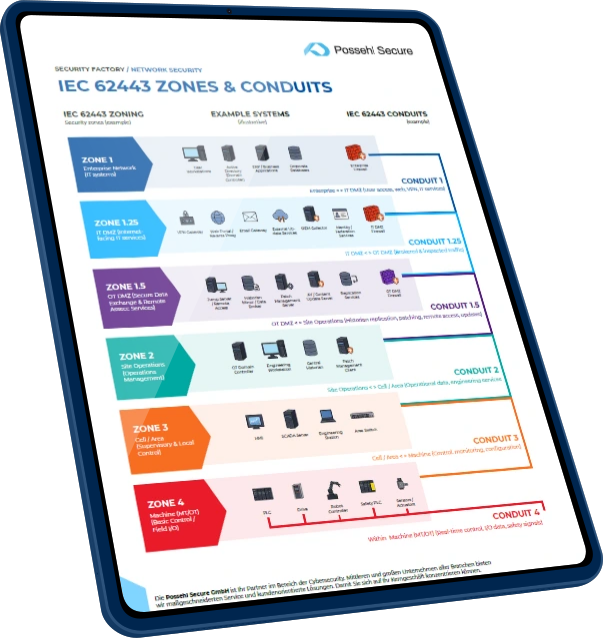
IEC 62443 takes a different approach: it groups systems into zones based on their risk and security requirements. The necessary communication paths between these areas are defined as conduits and controlled through appropriate security measures, such as dedicated or centrally deployed firewalls. IEC 62443-3-2 and IEC 62443-3-3 are particularly relevant to zoning.
Put simply, the Purdue model provides guidance on the hierarchical structure of an industrial environment. IEC 62443 complements this perspective with a risk-based division into zones and controlled communication paths. Zones therefore do not have to strictly follow individual Purdue levels: depending on the production process, systems at the same level may belong to different zones, or systems spanning multiple levels may be grouped into a single zone. The determining factors are operational dependencies and the consequences of a potential compromise.
More on the Purdue-Modell More on the zones and conduits model of IEC 62443
DOWNLOAD
IEC 62443 Zones & Conduits
We bring the Purdue Model together with the IEC 62443 zoning and IEC 62443 conduits into a practical overview.
Download the infographic here
>> IEC 62443 Zones & Conduits <<.
A controlled transition zone belongs between IT and OT
The boundary between corporate IT and production deserves particular attention. Management, monitoring, data exchange, and administrative tasks often require communication across this boundary.
Direct connections from IT to OT systems create unnecessary attack paths. An IT/OT DMZ (demilitarized zone) provides a controlled transition area between corporate IT and the production network. Required services and data flows are deliberately routed through it, rather than allowing direct access to production systems.
This also applies to external service providers. Remote maintenance is essential in many manufacturing companies. However, it should not create permanent, uncontrolled access to critical systems. This is where network segmentation and controlled privileged access go hand in hand: the DMZ limits the possible communication paths, while privileged access management (PAM) additionally controls administrative access.
In practice, this means restricting remote maintenance access to the systems required, granting it for a limited period, and monitoring it in a traceable manner. This allows external work to be carried out without creating an additional permanent attack path into production. CISA therefore identifies secure collaboration with external ICS integrators as a dedicated area of action for operators of OT environments.
Particularly critical systems need their own boundaries
Not all OT systems are equally critical, so they should not all belong to the same trust zone. Control, engineering, remote maintenance, and safety systems perform different tasks and carry different risks.
Which systems should be separated from one another, and which communication between them must remain possible, depends on their respective security requirements and the potential impact of a compromise.
In practice, this means that the greater the potential impact of a compromise on production, safety, or availability, the more closely access and communication paths must be controlled.
Effective zoning does not start with the firewall
Before technical security measures are planned, the production environment and its dependencies must be understood:
- Which systems and processes are particularly critical?
- Which communication is necessary for operation?
- Where are there direct connections between IT and OT?
- Which access paths do service providers or manufacturers use?
This provides the basis for developing a zone model with defined communication paths and appropriate technical controls. It reduces unnecessary attack paths while also revealing dependencies that could facilitate the spread of an attack during an incident.
In practice, however, implementation rarely takes place in a greenfield environment. IP addresses often cannot be changed without affecting controllers, machines, or manufacturer approvals. Historically evolved communication relationships are often only partially documented, while short maintenance windows and ongoing production limit the scope for action. In such environments, existing data flows are first observed and assessed step by step. New rules can then initially be monitored transparently and subsequently enforced in a targeted manner, without prematurely disrupting functioning production processes.
The goal: keeping a security incident from becoming a production incident
OT zoning prevents neither credential theft nor newly discovered vulnerabilities. Instead, it limits the options available to an attacker after a successful initial intrusion.
For manufacturing companies, this means addressing two layers of security: preventing attacks wherever possible while also designing the architecture so that a successful compromise cannot spread uncontrollably to other systems and production areas.
Well-planned zoning creates the necessary boundaries. It limits attack paths and helps contain a security incident as close as possible to where it began.
DOWNLOAD
IEC 62443 Zones & Conduits
We bring the Purdue Model together with the IEC 62443 zoning and IEC 62443 conduits into a practical overview.
Download the infographic here
>> IEC 62443 Zones & Conduits <<.
More articles on OT Security:
OT SECURITY
>> When cyber incidents impact production: What OT security has to do with business continuity <<
OT VISIBILITY
>> Blind spots in production networks: What needs to be visible for effective OT security <<
OT SOC (SECURITY OPERATIONS CENTER)
>> OT SOC: Connecting IT and OT telemetry to strengthen production security <<